Unveiling the Thrills: CS2 Case Opening Reveal
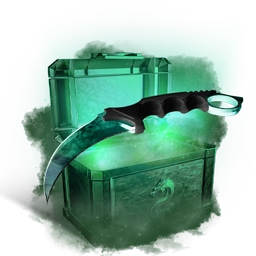
The Ultimate Guide to CS:GO (CS2) Case Opening: Odds, Economics, and the Thrill of the Drop
Few phenomena in modern gaming match the cultural impact of the Counter-Strike weapon case. Even with the transition from Counter-Strike: Global Offensive (CS:GO) to Counter-Strike 2 (CS2), the allure of the virtual unboxing remains a cornerstone of the community experience. Millions of players log on daily, drawn by the mesmerizing spin of a weapon case, hoping to land that elusive, factory-new knife or covert rifle.
However, behind the flashing lights and dramatic audio cues lies a complex system of probability, economics, and risk. This comprehensive guide explores the mechanics behind case openings, the statistical realities of the drop rates, and how players approach this digital lottery.
The Mechanics of a Case Opening
To open a case in CS2, a player requires two things: a specific weapon case (dropped randomly during gameplay or purchased from the Steam Market) and a corresponding key (purchased for a flat rate of £2.50 GBP in-game).
When a key is used on a case, an animation plays out. A grid of potential weapon finishes scrolls rapidly past a center marker, eventually slowing down to reveal the item won. While the animation creates genuine suspense, the item rewarded is actually determined the exact millisecond the player clicks “Open.” The spinning visual is purely theatrical.
Standard Case Drop Rates
Valve, the developer behind Counter-Strike, has historically kept exact drop rates under wraps, but regulatory pressures in certain countries forced transparency. Through official disclosures (specifically for markets like China), the baseline probabilities for standard cases have been well-established by the community and verified by large-scale data samples.
| Rarity Category | Item Classification | Approximate Drop Rate |
|---|---|---|
| Blue | Mil-Spec (Base Grade) | ~79.92% |
| Purple | Restricted | ~15.98% |
| Pink | Classified | ~3.20% |
| Red | Covert | ~0.64% |
| Special | Rare Special Item (Knives / Gloves) | ~0.26% |
As the table illustrates, players have roughly a 1 in 400 chance of unboxing a rare special item, such as a knife or pair of gloves.
The Economics of the Steam Market
Understanding case opening requires looking at the broader economic ecosystem of Counter-Strike. The game features a peer-to-peer marketplace where virtual items hold real-world monetary value.
Because the vast majority of items unboxed are lower-tier “Blues” and “Purples” that are worth only a few cents, the expected monetary return (ROI) of opening a case is significantly lower than the £2.50 cost of the key. Statistically, for every rare knife unboxed, hundreds of dollars worth of common weapon finishes are generated.
Why Do Players Keep Opening Cases?
Despite the negative expected return, case openings remain immensely popular for several key reasons:
- The Thrill of the Chase: The psychological hit of dopamine associated with gambling and near-misses keeps players engaged.
- Investment Potential: Certain rare items appreciate significantly over time, turning a lucky drop into a lucrative asset.
- Customization: Players enjoy personalizing their loadouts with unique aesthetics to stand out during matches.
- Content Creation: Streamers and YouTubers open cases in bulk, driving massive public visibility and fueling the trend.
Best Practices and Responsible Approaches
For those who choose to partake in case openings, maintaining a disciplined approach is crucial. Treating unboxings as entertainment rather than an investment strategy helps prevent financial regret.
Essential Tips for Case Openings
- Set a Strict Budget: Decide on a fixed amount of money you are willing to spend per month, and never exceed it to “chase losses.”
- Buy Skins Directly: If you want a specific weapon finish, purchasing it outright from the Steam Market or a reputable third-party site is almost always cheaper than trying to unbox it.
- Understand StatTrak™: StatTrak™ items track the number of kills made with that specific weapon and drop roughly 10% of the time alongside standard items, carrying a higher market value.
- View It as Entertainment: Expect to lose the money spent on keys. Consider the cost of the key as the price of admission for a few moments of excitement.
Frequently Asked Questions (FAQ)
1. Did the odds change when CS:GO upgraded to Counter-Strike 2?
No. The underlying drop rates, case mechanics, and rarity tiers remained consistent during the transition from CS:GO to CS2.
2. Are third-party case-opening websites safe?
Third-party gambling and case-opening sites operate outside of Valve’s official ecosystem. Many of these sites are unregulated, carry legal risks, and violate Steam’s terms of service. Players should exercise extreme caution and avoid sites that require logging in with primary Steam credentials.
3. Can I get a knife from any case?
No. Every case has a specific “pool” of potential rare special items. For example, Chroma cases drop Chroma-specific knives, while Operation cases often feature knives unique to that specific update. Always check the case contents list in-game before opening.
4. What happens to my old CS:GO cases in CS2?
All weapon cases, keys, and skins carried over seamlessly from CS:GO to Counter-Strike 2. Their functionality and market values remain intact.
The world of CS:GO and CS2 case openings is a fascinating intersection of gaming, psychology, and virtual economics. While the odds heavily favor the house, the allure of unboxing a pristine, high-tier knife continues to captivate millions. By approaching case openings with informed expectations and strict financial boundaries, players can enjoy the excitement of the drop without falling victim to the pitfalls of digital gambling.
Explore CS2Skin for an exciting Case Skin experience, discover rare CS2 skins, and see what your next virtual case reveals.